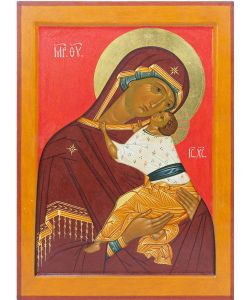
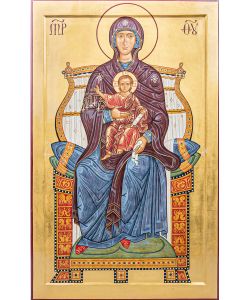
Icon, Our Lady of the Gate of Dawn of Vilnius 25x25 cm
Icon hand painted with the Byzantine technique.
Egg tempera with natural pigments such as earths and minerals.
Bole gilding with 23 3/4 kt pure gold leaf.
Icon painted in Italy.
The Mother of God Ostro Brama is a Christian icon from the second half of the 16th century, named after the Ostra Brama (city gate), a monument of Vilnius architecture. The image of the Mother of God was placed at the gates of Vilnius, the capital of Lithuania. The icon is venerated by believers of both Western and Eastern rites and is one of the main shrines of Lithuania and Vilnius. The work was soon considered miraculous, inspiring a cult. A chapel dedicated to her was built in 1671 by the Discalced Carmelites. At the same time, in accordance with Eastern Orthodox Christian tradition, the painting was covered in silver and gold, leaving only the face and hands visible. The painting depicts Mary's complex personality and devotion. Her head is gently bowed to the right, her eyes are half-closed, and her hands are crossed in a sign of devotion; this reminds us that she is a virgin, a humble servant of the Lord, a merciful mother, and the patroness of the people. At the same time, her head is surrounded by the sun's rays, and her body is usually covered in elaborate robes and gold and silver crowns; these are symbols of her divine and majestic role as Queen of Heaven. Our Lady's head is adorned with two crowns. Two little angels lower the large Rococo crown with stained glass inserts onto the smaller Baroque crown. Some have argued that the two crowns, which resemble royal and ducal insignia, represent the Kingdom of Poland and the Grand Duchy of Lithuania, respectively.
| Icon, Our Lady of the Gate of Dawn of Vilnius 25x25 cm | Stock: 1 - COD. MADVILN25X25 | |||
| € 598,00 |

|
|||